Wednesday, October 27, 2010

Glenn Beck’s Rally, the 9/11 Mosque, and the ties that bind.


We can see the Enlightenment assumptions underlying the American Right and Left in two events from last month: Glen Beck’s Restoring Honor Rally and debate over the 9/11 Mosque.

Here is Harvey Mansfield on the ‘Restore Honor’ Rally:

“Glenn Beck is a kind of libertarian, and he has made a fair amount of money. But he rejects the private life that libertarians seem to recommend. He goes public with his distrust of everything public and thus requires libertarians to march behind patriotism, religion, and honor—all things not in your immediate self-interest.”

Usually, Libertarians want to reject loyalties to country or God and replace it with enlightened self-interest. Their belief is these traditional loyalties are merely irrational prejudices and so they can’t provide the basis for public policy. Yet appealing to your self-interest isn’t going to inspire the public in a rally. And its not going to unite the citizenry together either. In the end, calculation and contract are not enough to form a community.

Lets see how similar thinking underlies the Left’s view of the 9/11 Mosque. Liberals criticize Conservatives for manifesting “what the ancient political philosophers called “the love of one’s own.”

Liberals believe this preference creates a distinction between insiders and outsiders. For example, the current controversy is making Muslims feel like outsiders. And since no one should be made to feel like an outsider, Liberals reject the “love of one’s own” as unjust.

Carson Holloway explains how this view began in the Enlightenment:

“Liberals act in these ways in part because contemporary liberalism is abstract and rationalistic in its philosophic roots. Liberals are still in important respects children of the Enlightenment and still hold dear its universalistic assumptions and aspirations. The Enlightenment hoped to usher in an empire of the “rights of man,” to establish society on the basis of what is owed to human beings as human beings, and accordingly rejected older, more partial loyalties—to clan, country, or faith—as merely arbitrary.”

The commonality between the Libertarians and Liberals then is they strip human beings of all ties which make life meaningful (faith, family, and friends). Both reject patriotism; Libertarians replace it with collective selfishness while Liberals emphasize cosmopolitanism e.g. they’re citizens of world (which is to say they’re citizens of no place in particular).

Is the “love of one’s own” aka inherently unjust? Holloway thinks not:

“From another perspective, however, one might contend that such loyalty is perfectly rational—in the sense that, while every man would admit that his father has no particular claims on the human race, every man would equally claim that a father does have a very powerful claim on the help and affection of his own son.”

Instead of rallying around the flag, these Enlightenment extremes would either say every man for himself or we shouldn't play favorites when it comes to attending rallies.

Wednesday, October 6, 2010

Its not an Either/Or


The American Right and Left commit the same error when it comes to politics. See if you can catch it.

On the Right, Glenn Beck was interviewed by NY Times Magazine: "Progressives speak of putting “the common good” before the individual, which “is exactly the kind of talk that led to the death camps in Germany,” as he said on his show in May."

On the Left, Slate’s William Saletan argued Christine O’Donnell is a Socialist because she believes certain private acts which occur in the bedroom are immoral.

Catch it? In both instances, the reader is given a false dichotomy. The suggestion is there are only two choices, individualism or collectivism, when really there are more. Ross Douthat explains: “[they’re] reflecting the modern tendency to reduce all of human affairs to a state/individual binary (or a Marx/Rand binary, if you will), with no room for family, community, and other intermediate areas of effort, collaboration and self-sacrifice." Beck and Saletan mistakenly think that any denial of an individual right is an endorsement of the centralized government.

Both sides of the political spectrum see the only possibilities for ordering society are two Enlightenment extremes: Individualist Capitalism or Totalitarian Government. If that's the case, its just a matter of picking your poison.

Wednesday, September 29, 2010

Our Founding Liberals?

Is there a straight line from the Founding Fathers to President Obama? Patrick Deneen thinks so.

He criticizes Glenn Beck's Claremont view of American History. Admittedly, this view incorrectly reduces American History to: Founders=Locke=Good v. Progressives=Hegel=Bad.
It is not that easy.

That being said, my POMO Con response to Deneen would look like this: Professor Deneen’s argument is the Progressives corrected or completed the project begun by the American Founders. The Founders inconsistently exempted human nature from the “conquest of nature” while the Progressives thought human nature had to be conquered as well. But it seems like the Founders were right on that score. Human nature is distinct from Nature. We are not “nature fodder” or parts of a whole; we’re wholes. Pascal’s observation of our restlessness is a sign of our distinctiveness, that ultimately we’re lost in the cosmos. The Progressives do not complete the Founding, they reject it.

Moreover, Progressives like TR and FDR were not anti-human nature i.e. they supported the traditional family (#5 on Deneen's list). Allan Carlson has written about this and labeled them 'maternalists'. They simply rejected limited gov't (#1 on Deneen's list) in favor of safety nets to protect the family. They use modern liberal means for socially conservative ends. They might be called ‘Political’ Liberals. The rejection of human nature as a standard doesn't come until the Sexual Revolution of the 1960's. We might call supporters of this era ‘Cultural’ Liberals. Modern Technology like Birth Control and Abortion are used to divorce women from their baby-making equipment. Political Liberals opposed these things which are now celebrated as making us free (from nature). The real question is not whether the Progressives complete the Founders, but whether the Cultural Liberals complete the Political Liberals.

Thursday, August 12, 2010

To thine own self be deceitful?


*Plot spoilers below


A recent conversation with a friend has helped me see a reoccurring question through Nolan’s films. Is lying to oneself or the community necessary for survival? Does man require ‘myths’ or ‘illusions’ to keep himself going? These questions can be seen in all of his films in some form.


Memento: The hero (Guy Pierce) cannot make new memories since he and his wife were attacked. He is on a quest to avenge the murder of his wife until he finds out that he has already caught and killed the attacker over a year ago. He has been lying to himself, creating “a puzzle he could not solve”, in order to give his life meaning. In the final scene, he decides yet again to forget this truth so he can keep going.


Insomnia: The hero (Al Pacino) is a detective who is considered a white knight because of all the people he has put behind bars. It turns out, however, this white knight is really a dark knight because on one occasion he doctor-ed the evidence in order to get the criminal convicted. This leads to a slippery slope in which he commits murder to cover up his earlier misdeed. An up and coming detective discovers the truth and is faced with a dilemma: if she turns him in, that will reopen all the cases which he closed legitimately. The hero tells her to do it anyway; otherwise “she, too, will lose her way.” This film is especially interesting because it is the only one which Nolan sides with telling the truth.


Dark Knight: Gotham’s “White Knight” Harvey Dent is corrupted by the Joker so Batman and Commissioner Gordon decide to hide the truth from the public because it would cause the city to lose hope.


Inception: The hero (Leonardo Dicaprio) has to pick between living in a dream or reality. In what APPEARS to be the climactic scene, he tells his wife he chooses reality; however, in the final scene the audience is left wondering whether he made it out of the dream or not. What is often overlooked is that he does not care either way. Whether or not the spinning top will stop is the clue to figuring out if he is in a dream or not. The audience is eagerly watching the top or ‘totem’, but he is not. He spins the top and then hugs his children; he is indifferent to whether the top will fall or not. His children could be a false image, yet he doesn’t seem to mind.

In all the films, but one, Nolan takes the side of lying. Why the anomaly? I’m not sure. The overall theme though is Myths or illusions are necessary to maintain life. Postmodern? No, but it isn’t exactly rosy either.

Tuesday, July 27, 2010

There's no place like home

*Plot spoilers below

Musings on the film in no particular order...

1) Too much time was spent expounding upon the rules which govern dreams. Rules should simply set up the story, not take the place of it. The rules are so intricate they require several scenes to explicate them.

2) The ambiguous ending co-opts the rest of the film. Audiences will be spending all their time debating what happened at the end instead of arguing about the film as a whole. This is a waste of time UNLESS the ending is essential to the overall theme. In which case, it is important to know how it ends. Or it could be that AMBIGUITY itself is the overall theme.

3) Thomas Hibbs argues in Arts of Darkness that there is a subset of films within American Noir which "characters engage in a kind of quest to recover something." Since these movies are a subset of Film Noir, they do not find what they're looking for, but movies avoid nihilism because the characters have "some sense of proper orientation; of not losing oneself."

Inception definitely falls into this category. Cobb wants to "recover" his children and spends the entire film trying to do so. In film's climax, Cobb is tempted to choose between living in a dream world or going home to his real kids. He orients himself correctly by picking reality. Yet in the final scene we are left with the possibility that his real kids are not real at all and that he is still stuck in a dream. Does this make the film nihilistic? Hibbs' argument is it can escape the nihilism charge even if Cobb does not make it back to his kids because he at least oriented himself correctly. He WANTS to return home. That he isn't there yet is another matter.

What happens to Hibbs' argument if Cobb is CERTAINLY trapped in a dream? I think Hibbs would say it is nihilist then because there has to be at least the possibility of a recovery.

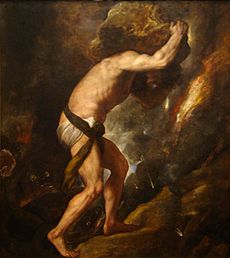
Albert Camus, on the other hand, argued in the Myth of Sisyphus that meaning was still possible in such a situation: "The struggle itself...is enough to fill a man's heart. One must imagine Sisyphus happy." But this answer doesn't seem satisfying. It just sounds like playing pretend. And most of us lost that attitude when we grew up.

4) James Bowman, in an essay titled "Avatar and the Flight from Reality," uses recent films to show how ancients and (post) moderns view art's purpose. Ancients believed in the concept of 'mimesis', in which art is evaluated by how successfully it reflects or imitates reality. Postmoderns flip things around and make art the measuring stick for reality. Cobb and Mal created a dream so beautiful that Mal did not want to leave. Ariadne says what they're doing is "pure creation."

So did I like the film? Yes. Is it Nolan's best work? No. His worst reviewed film, The Prestige, is better. But then again, The Prestige was really good so that isn't a harsh criticism about Inception.

Thursday, July 15, 2010

BSG Series Finale

*Plot spoilers below

While the show ended two years ago, I only now just got around to finishing the series. Here are some 'musings'...

1) The Show always presented a debate between monotheists, polytheists, and atheists on the question of God's existence. In the finale, it turns out the monotheists were right all along. What was not up for debate between the Humans and Cylons were the permissive sexual attitudes practiced on both sides. If there is a God or gods, the assumption was, he or they do not concern themselves with such trifles. In light of this persistent theme through five seasons of the show, the finale took a rather puzzling turn.

Flashbacks are presented depicting Caprica before the Cylon attack. We see Tigh, Ellen, and Adama at a club and Roslin considering having an affair. They're not living very admirable lives and their lives are depicted as banal. The suggestion is the attack and consequent struggle for survival afterwords brought forth the best out of them.

In the final scene of the episode, human civilization has returned back to the level (population, technology) it had reached in Caprica. God finds the same problems with this civilization as he had with Caprica. And the list of sins is rather traditional e.g. materialism, debauchery, etc. Ultimately, the Divine is not the Libertine the Show originally made him out to be.


2) After discovering Earth, the Humans and Cylons decide to give up the technology they possess and start all over. They will live simply and even intermingle with the human savages on earth. The hope is this will break the cycle of violence. The Final Five explained in a previous episode that Caprica's destruction and the ensuing aftermath was part of some sort of cyclical pattern. The implication is technology is the source of evil and Humans and Cylons can live in peace if they live without such relishes. It all sounds like Rousseau who argued that the advance of civilization was the regression of man. The 'noble' savage in the state of nature is morally good and it is civilization which corrupts him.

The conclusion takes place thousands of years later and we see civilization has developed in spite of Human/Cylon decision to forgo technology. And as I said in the previous point, this civilization has developed the same problems of the last one. This is because the source of evil is not in the material circumstances, but the human (or cylon) heart. Even if they live as noble savages, there is nothing to stop subsequent generations from developing technology. And if they choose not to develop it, that does not remove the possibility of malice, rage etc. They might not have battlestars to kill each other with, but they will have stones.

3) The suggestion that God will destoy Earth in the last scene is especially troublesome because it means Adama and Co. were unable to end the cycle of violence. In effect, they failed. This is strange since we have been rooting for these characters over five seasons and we find out in the last episode that their success is not final in any sense. Their attempt to achieve peace was ultimately in vain.

That being said, BSG attempted to answer as many questions as it raised, which is more than can be said for LOST.

Sunday, July 4, 2010

The Missing Link


Modern Liberal rhetoric on abortion has changed over the years. It used to be portrayed as a positive good, but is now depicted as a necessary evil, hence President Obama's characterization of it as "tragic." This is probably due to our country's slight shift in a pro-life direction. Professor Naomi Cahn, one of the two co-authors of the book Blue Families v. Red Families, recognizes this and so she wants to change the subject and talk about contraception instead. But isn't there a link between birth control and abortion? Does access to birth control increase abortion rates? If it increases abortion rates, then Modern Liberals would be endorsing a policy which would increase something which they themselves admit is "tragic."

Ross Douthat points out the same states (e.g. Massachusetts) which uses public funds to increase access to birth control also have higher abortion rates than states (e.g. Mississippi) which do not. Cahn's attempts to explain this away by saying the problem is states like Massachusetts have not gone far enough. They need further funding of sex ed and even easier access to birth control. Yet this seems highly implausible; the more likely explanation is abortion is necessary as a backup when contraception fails. This is why the abortion rates go up in states which permit easier access to birth control.